Cubans seek solutions and solace in Santería amid crises

While nearly 70 per cent of Latin America’s 670 million people consider themselves Catholic, in Cuba, Santería is the name of the game.

- Advertisement -
Journey to Kingston-728x90

From a two-room concrete home on the fringes of Cuba’s capital, the rumble of wooden drums spills out onto the streets.

Neighbors gather at the door and kids climb a fence to peer inside. They watch as dozens of Cubans wearing white and African beads make offerings at a bright blue altar consuming half a room, asking for luck, protection and good health.

A fusion of African religions and Catholicism, Santería was one of the few religious practices to quietly endure through decades of prohibitions and stigma by the communist government.

Now, as that stigma gradually fades and the country enters a moment of compounding economic, political and migratory crises, the religion is growing in popularity and expanding to new demographics.

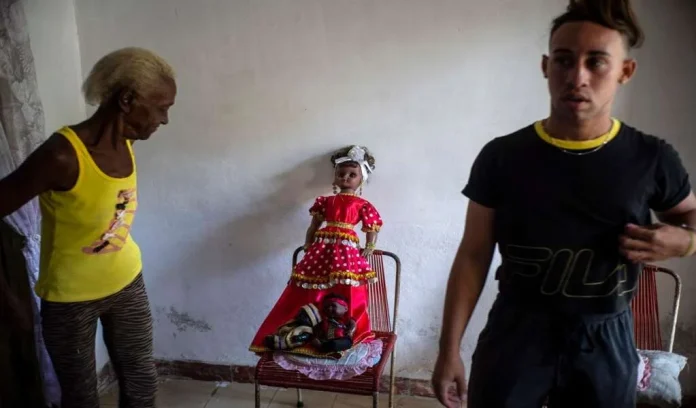
“Every day the religion grows a little more,” Mandy Arrazcaeta, 30, said among the throngs of people in his home dancing and making offerings at the altar to a plastic doll depicting the Yoruba deity Yemayá. “Right now, Santería in the country is a sort of bastion.”

Palooza 728x90

Santería was born as a form of quiet resistance among the island’s black communities. The religion dates back centuries to when Spanish colonists brought in hundreds of thousands of African slaves.

While the Spanish tried to force Catholicism on the slaves, the Africans brought their own religions, mostly from West Africa, which they would camouflage by attaching their deities — orishas — to Catholic saints.

Cuba’s patron saint, Our Lady of Charity, for example, blended with the golden deity, Oshun.

- Advertisement -
Uber Free Rides 728x90

“It would mix and mix … through this Catholic virgin, they would speak to their African saints,” explained Roberto Zurbano, a Cuban cultural critic. “That’s how the religion was able to survive.”

While there are hundreds of orishas in Santería, practitioners known as santeros usually worship only a handful, connecting with them through rituals and offerings.

On one Friday night, Arrazcaeta, family and friends splay out offerings of coconut and red Cuban pesos emblazoned with the face of Che Guevara, sacrificing two chickens over bowls filled with rocks and seashells. In exchange, they ask for good health, strength during hardship, and even luck in love.

“It’s something that’s very Cuban, something spontaneous that we do. Because we know the struggles we face in this country,” Arrazcaeta said.

Millions worldwide are estimated to practice Santería, though definitive numbers – especially in Cuba – are hard to pin down due to the religion’s informal nature. The US Commission on International Religious Freedom estimates 70 per cent in Cuba practice some version of Santeria or similar African-based religions.

AP/

More Stories

Jamaica tufton Ministry of Health

Jamaica to develop national fertility strategy amid falling birth rate concerns

Health and Wellness Minister Christopher Tufton has announced plans for a National Fertility and Family Support Strategy aimed at addressing Jamaica’s declining birth rate,...
CARICOM Caribbean general elections

CARICOM Election Observation Mission says Bahamas 2026 polls peaceful, orderly

The Caribbean Community (CARICOM) Election Observation Mission (CEOM) has reported that The Bahamas’ 2026 general election was conducted in a peaceful and orderly manner,...
Club Kingston

Club Kingston named Priority Pass Lounge of the Year for Latin America and Caribbean

The Jamaica Tourist Board (JTB) has lauded Club Kingston after it was named Priority Pass Lounge of the Year – Regional Winner for Latin...
Antigua and Barbuda Electoral Commission

Antigua election commission rejects fraud claims, warns of possible legal action

The Antigua and Barbuda Electoral Commission (ABEC) has strongly rejected allegations questioning the legitimacy of Antigua and Barbuda’s April 30 general election and warned...
Trinidad Prime Minister Kamla Persad-Bissessar

Trinidad and Tobago refuses to recognize CARICOM secretary general beyond August

Prime Minister Kamla Persad-Bissessar says Trinidad and Tobago will not recognize Dr. Carla Barnett as Secretary General of the Caribbean Community (CARICOM) after her...
Andrew Holness and Mark Golding

Jamaica ranked Caribbean’s top country for electoral democracy in UNDP report

Jamaica has retained its position as the leading country in the Caribbean for electoral democracy, according to the 2025 Electoral Democracy Index featured in...

Belize highlights CARICOM opportunities for youth during panel discussion

Belizean students and young professionals gathered in Belmopan on Tuesday for a panel discussion focused on the opportunities available through Caribbean regional integration as...
A resident in Black River, St. Elizabeth, repairs his roof in the aftermath of Hurricane Melissa.

Jamaica audit finds only 1.8% of Hurricane Melissa donations spent months after storm

Jamaica’s disaster response system is under scrutiny after an audit revealed that only a small portion of the billions donated for Hurricane Melissa recovery...

Davis, PLP reelected in Bahamas landslide election victory

Bahamian Prime Minister Philip Davis and his governing Progressive Liberal Party secured a decisive reelection on Tuesday, positioning Davis to become the first Bahamian...
plane

10 rescued after Bahamas-origin plane crashes off Florida coast

A U.S. Coast Guard rescue operation on Tuesday successfully recovered all 10 people aboard a small aircraft that crashed off the Florida coast shortly...

Latest Articles