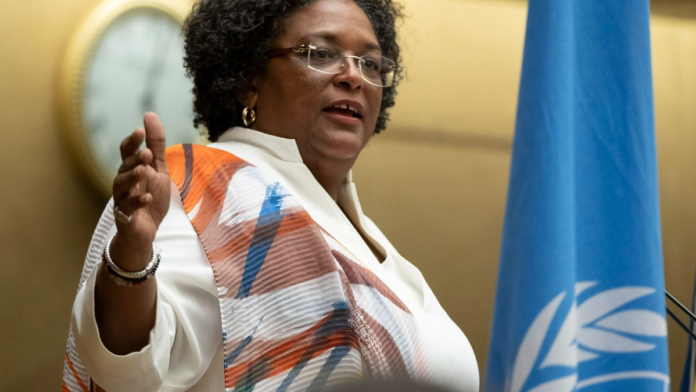
Caribbean heads of government, along with world leaders, recently adopted a ‘Pact for the Future’ to address 21st-century challenges, such as conflicts and artificial intelligence.

During the gathering, Barbados’ Prime Minister, Mia Mottley, emphasized the need for a shift in attitude and values in response to these challenges. This pact represents the most comprehensive international agreement in many years, encompassing new areas as well as longstanding issues that have previously lacked consensus. Its goal is to ensure that international institutions can effectively respond to the dramatically changing world.
The United Nations described the agreement as the result of an inclusive, years-long process aimed at aligning international cooperation with the realities of today and the challenges of tomorrow.

Leaders have outlined a vision for an international system that can fulfill its promises, is more reflective of today’s world, and leverages the energy and expertise of governments, civil society, and other key partners.
During the summit’s opening, Secretary-General Antonio Guterres stated, “The ‘Pact for the Future,’ the ‘Global Digital Compact,’ and the ‘Declaration on Future Generations’ present new opportunities and unexplored possibilities.” The 42-page pact addresses a wide range of issues, including peace and security, sustainable development, climate change, digital cooperation, human rights, gender, youth, future generations, and the transformation of global governance.
At the summit’s closing ceremony, Mottley emphasized that change is achievable with sufficient effort, stating, “I believe that it is possible for us to have a win-win; I believe that hope can be restored. But I do recognize that we are at a turning point. Those in power who seek to maintain the status quo are determined not to create the space or the policy flexibility, or provide the necessary funding for us to include others, even though they do not yet have a plan for us to live on Mars.”

“It is unconscionable for us not to recognize that unless we can provide the basics of food, water, shelter, electricity to all people on this earth, we cannot talk about being a successful generation in human civilization,” the Barbadian leader said.
The Summit brought together over 4000 individuals from heads of state and government, observers, IGOs, UN System, civil society and non-governmental organizations.
In a broader push to increase the engagement of diverse actors, the formal summit was preceded by the action days from September20 to 21, which attracted more than 7,000 individuals representing all segments of society.

The action days featured strong commitments to action by all stakeholders, as well as pledges of US$1.05 billion to advance digital inclusion.