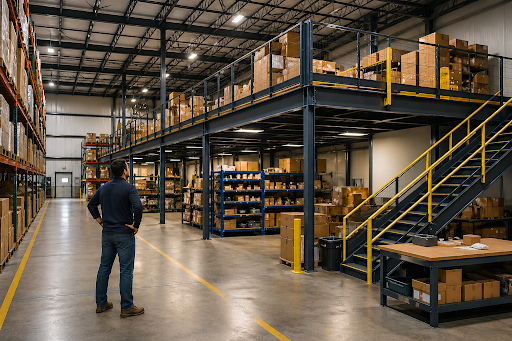
Ever noticed how a warehouse can feel “full” long before it actually is?
You walk in, hear the low hum of forklifts, see boxes creeping into walkways… and suddenly everything feels tighter than it should.
According to the Warehousing Education and Research Council, more than 70% of warehouse operators say space utilization becomes a problem as they grow.

Not shocking. Growth rarely arrives in neat, predictable layers.
Still, knowing that doesn’t make your daily operations any easier when everything feels squeezed. The good news? You don’t always need more square footage. Sometimes, the space you already have just needs to… work harder. Let’s get into it.
The Everyday Strain of Running Out of Space
Space problems rarely show up dramatically.
They build slowly. A few extra SKUs, a bulk order that overstays, maybe some safety stock that never gets used. Then one day, everything feels cramped.
And the impact? It sneaks into everything.
Picking gets slower. Errors start creeping in—wrong items, missed lines. According to OSHA, poor warehouse organization contributes to thousands of workplace injuries each year. Tight spaces aren’t just inconvenient… they’re risky.

Then there’s the inventory side of it.
IHL Group estimates that inventory distortion costs businesses around $1.7 trillion globally every year. Overstocking plays a big role in that—and a lot of it just sits, quietly eating up space.
You’ve seen it.
Boxes untouched for months. Items no one’s asked for in ages. And above it all—empty air, doing nothing. Kind of ironic, isn’t it?
Practical Shifts That Create Space Without Expansion
So, here’s the pivot.
Instead of chasing more square footage, start looking at what’s already there. The gaps. The inefficiencies. The habits that formed without anyone really noticing.
Here’s how to do it right.
1. Turn Overhead Space Into Something Useful
Look up for a second.
That vertical gap above your racks? It’s not decorative. It’s potential.
Most warehouses leave a surprising amount of vertical space untouched. Installing a mezzanine can change that—suddenly, you’ve got a second level for storage, packing, even light assembly.
The Material Handling Institute reports that mezzanines can increase storage capacity by up to 50%. That’s not a small improvement.
Now, sourcing one is where things get interesting. You could go fully custom-built, tailored to your exact layout.
You can also find a used mezzanine system that can be significantly more affordable and often available for faster installation, which matters when you’re already feeling squeezed. Still, placement matters more than the structure itself. You don’t want to fix one bottleneck and create another.
2. Organize Based on Movement, Not Convenience
Here’s where things get… a little human.
We tend to store items where it’s easiest at the moment. Not where they belong long-term. Over time, that creates friction you can’t quite explain. You just feel it.
The Pareto Principle shows up here again—around 80% of your orders likely come from 20% of your products. McKinsey has backed this pattern across supply chains.
So, treat those items differently. Keep fast movers within easy reach. Push slower ones out of the way—higher shelves, deeper racks.
3. Rework Aisles That Are Quietly Wasting Space
Aisles are deceptive.
They feel necessary—and they are—but they often take up more room than they should.
Industry warehouse design guidance shows that narrowing aisle widths—when compatible with equipment—can improve storage density by roughly 10–25%, with higher gains possible in very narrow aisle systems depending on layout and machinery.
Still, there’s a balance. Too tight, and operations get tense. One wrong move with a forklift, and things go sideways fast. But if you approach it carefully, with the right equipment and training, you unlock space that was hiding in plain sight.
4. Replace Patchwork Racking with Smarter Systems
Some warehouses grow in layers.
A rack here. Another there. Over time, it becomes a patchwork—functional, but not efficient.
That’s where high-density racking systems come in. Drive-in racks, push-back systems… they’re designed to store more in less space without turning everything into chaos.
Still, it works best when your inventory patterns aren’t wildly unpredictable. If they are, you’ll need a mix of systems that can adapt.
5. Clear Out Inventory That’s Quietly Taking Over
This one’s tough.
There’s always that stock you hang onto “just in case.” It sits. And sits. And somehow spreads. Before you know it, it’s everywhere.
A simple approach helps—review items that haven’t moved in 12 months. Discount them, bundle them, or clear them out. That space is more valuable than the possibility of a future sale.
One warehouse supervisor described the process as “finally seeing the floor again.” That image sticks with you.
Space Feels Different When It Starts Working With You
It’s not dramatic. More like a quiet shift.
Your team moves more smoothly. Fewer bottlenecks. Less hesitation. You stop hearing as many “Where is this?” questions echo across the floor.
Same building. Same walls. Just… better use of what was already there.
And maybe that’s the part worth sitting with for a second.
Space doesn’t always disappear—it just gets buried under habits, decisions, and time. Change those, even slightly, and suddenly, there’s room again.