Imagine a scenario where a single unauthorized entry into a municipal data center compromises the private records of every local resident. The stakes for government security transcend simple property protection because a breach can dismantle public trust and paralyze essential services.

Moving beyond traditional locks and keys is no longer a luxury for agencies. It is a fundamental requirement for maintaining the continuity of our most critical civic operations.
Establishing High Level Perimeter Defense
Government facilities require a defensive posture that begins long before a visitor reaches the front door. Smart fencing equipped with fiber optic sensors can now detect the exact vibration of a climbing attempt while ignoring wind or local wildlife. Across the US, security related incidents at public facilities likely total in the dozens to low hundreds each day, making these initial barriers the first line of defense against escalating threats.

Integrated lighting and thermal imaging cameras work in tandem to eliminate blind spots during overnight hours. It works, threats are steadily rising, smart sensors offer real safety. With this proactive approach, security personnel receive alerts the moment a boundary is crossed, allowing for an immediate response rather than a retrospective review of recorded footage.
Implementing Government-Grade Surveillance and Access
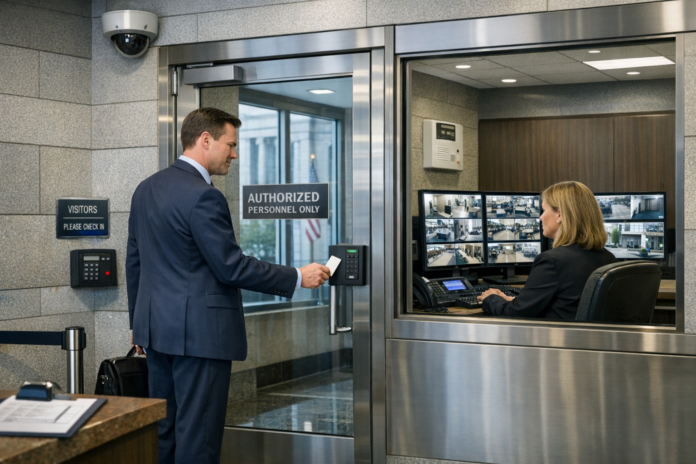
Modern access management has shifted from simple ID badges to sophisticated identity-based frameworks that verify every individual in real time. Using these systems, administrators are able to monitor movement throughout a building and adjust user permissions instantly through remote management tools. Deploying government-grade surveillance ensures that high-security zones remain restricted to authorized personnel without slowing down the daily flow of public business.
Effective access control requires a combination of physical hardware and digital oversight to be truly successful.

- Biometric scanners that utilize iris or facial recognition
- Encrypted smart cards that prevent credential cloning
- Mobile based keys for temporary contractor access
Advanced Video Analytics and AI Monitoring
Artificial intelligence has transformed video monitoring from a passive recording tool into an active participant in building safety. Modern systems can automatically identify abandoned packages or detect the specific acoustic signature of a glass break. This technology allows a small security team to oversee massive complexes by highlighting only the events that require human intervention.
Integrating Physical and Digital Security
The convergence of physical hardware and IT networks means that every camera and card reader is a potential entry point for hackers. Protecting these assets requires a zero-trust architecture where every device is authenticated before it can communicate with the server. Many agencies are now utilizing red team penetration testing to find vulnerabilities in their digital perimeters before malicious actors can exploit them.
Watch the network closely, cyber threats move much faster now, digital backed physical hardware provides the only true shield. Hardening these systems ensures that a physical security upgrade does not accidentally create a digital back door into the government network.

Standardizing Compliance and Federal Guidelines
Adhering to strict regulatory frameworks ensures that security remains consistent across different departments and jurisdictions. Whether following NIST guidelines or local mandates, these standards provide a roadmap for maintaining high levels of protection. Most modern upgrades are now focused on touchless entry management to meet health and safety standards while simultaneously improving facility security.
Balancing Public Access with Internal Safety
Government buildings must remain accessible to the citizens they serve while keeping employees and sensitive data safe. This balance is often achieved through a concentric circles design where public areas are clearly separated from restricted office wings.
Wait for it, the security balance is rapidly shifting, modular design remains the most effective strategy for facilities. Using clear signage and natural wayfinding can guide the public toward service desks while subtly steering them away from secure zones.
Developing a Resilient Security Strategy
A truly effective system is never static because the nature of threats is constantly evolving. Regular audits and staff training sessions are just as important as the latest cameras or sensors. Building a culture of security awareness among employees creates a human firewall that complements the technical layers already in place.
Future Proofing Your Facility
The landscape of physical protection is moving toward more unified and intelligent platforms. Strategic upgrades allow agencies to stay ahead of risks while improving the efficiency of daily operations. You can find more inspiring and related topics by reading through our other recent articles on the blog.