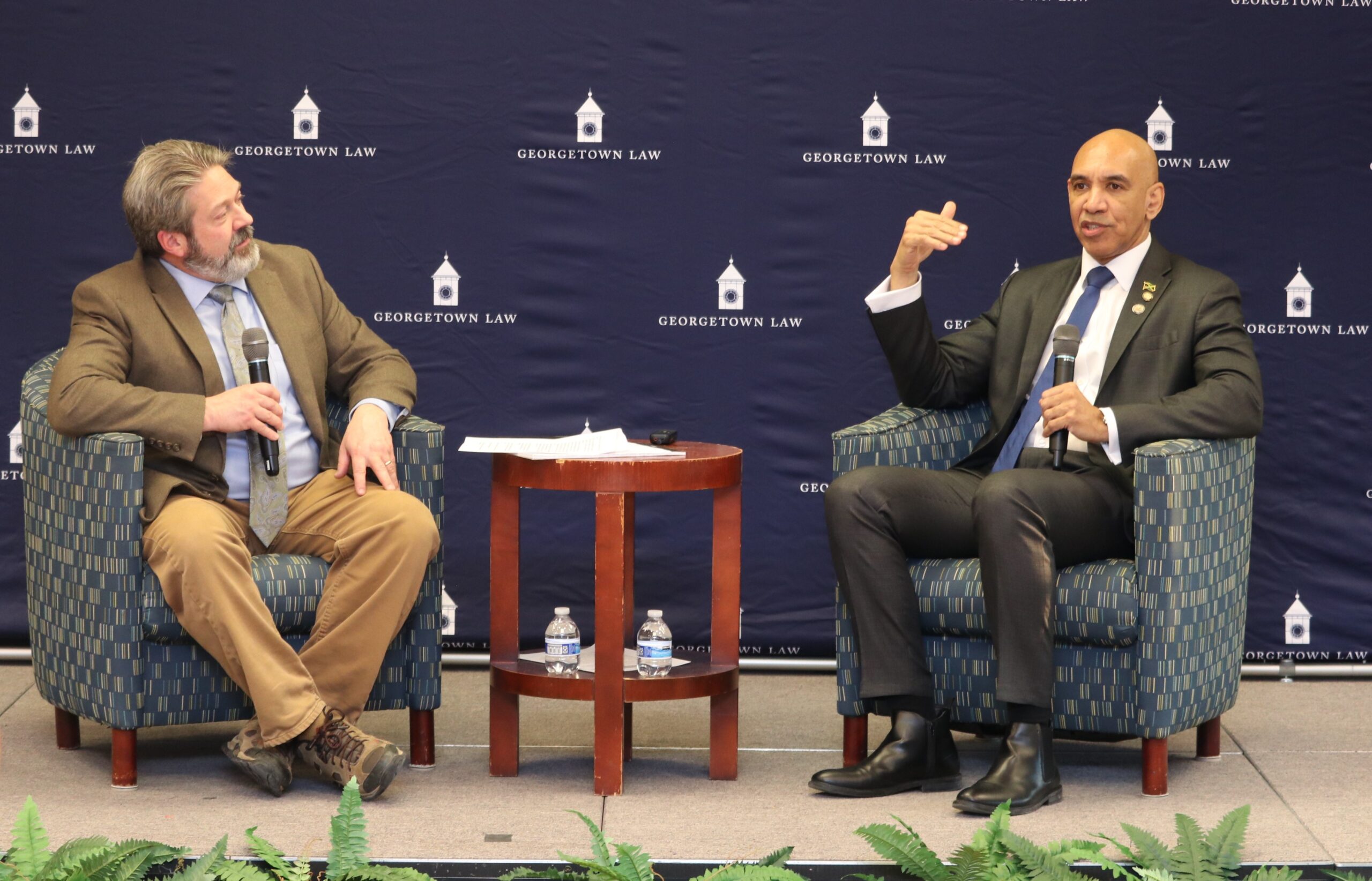
Jamaica’s Ambassador to the United States, Major General (Ret’d) Antony Anderson, has warned that transnational organised crime remains the most serious security threat facing the Caribbean, while pointing to Jamaica’s recent crime reductions as evidence that sustained reform can deliver results.
Anderson made the remarks during a public forum at Georgetown University Law Center in Washington, D.C., held under the theme “Jamaica’s Role in Regional Security: U.S.–Jamaica Cooperation.”
“Transnational organised crime that manifests through violence is the most significant threat to the security of our nation and the region,” Anderson said. “It is a business, and to sustain that business and its networks, those involved rely on violence or the threat of violence, undermining governance and exploiting borders in ways no single country can confront alone.”

He cited the United Nations Office on Drugs and Crime (UNODC) 2023 Global Study on Homicide, noting that the Caribbean continues to record the highest homicide rates globally. According to the report, 50 per cent of homicides in the region are linked to guns and gangs, compared with a global average of 24 per cent.
Drawing on his tenure as Jamaica’s commissioner of police from 2018 to 2024, Anderson highlighted what he described as historic security gains. Jamaica recorded its lowest homicide rate in more than three decades in 2025, reflecting a 40 per cent reduction, or 24 per 100,000 people. This followed declines of 8 per cent in 2023 and 19 per cent in 2024.
He said the downward trend has continued into 2026, with January registering a 55 per cent reduction in murders — the lowest monthly figure since record-keeping began in 2001.
“What you are seeing is the result of political focus, sustained strategies, and consistent investment in a security architecture tailored to our realities,” Anderson said. “We decided as a country to take ownership of our problem. No one is coming to fix it for us. Reform requires persistence, even through the difficult phases.”
Anderson also underscored the importance of institutional reform and leadership, pointing to Jamaica’s efforts to modernise its security forces and strengthen intelligence capacity. He said the country has worked to build a modern police force supported by technology, quality management systems and succession planning.
While emphasising Jamaica’s own reforms, the ambassador highlighted the importance of cooperation with the United States, describing it as one of the strongest law enforcement partnerships in the region.
“That cooperation has disrupted major narcotics trafficking networks, strengthened information sharing, and enhanced operational interoperability,” he said. Anderson added that Jamaica has been encouraged by bipartisan support in Washington to address the flow of illegal firearms into the Caribbean, alongside legislative reforms to Jamaica’s Firearms Act.
Looking ahead, he said Jamaica’s security progress should be seen as a pathway to long-term stability and development.
“Peaceful societies are not docile societies,” Anderson said. “They are societies where competition does not become conflict. The trends show we are moving toward safety, not just in reducing murder, but across all crime categories. The next stage is peace.”
He urged regional partners to document and share best practices, noting that Jamaica’s experience could help other countries facing similar challenges.
“What affects our neighbours affects us all,” Anderson said. “Our responsibility extends beyond our own shores.”