



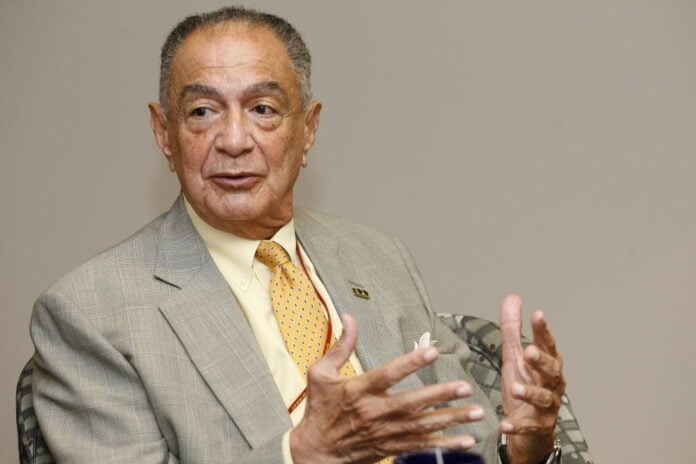
Jerome Gary Cooper, former United States Ambassador to Jamaica and American Friends of Jamaica (AFJ) Director Emeritus, has died.

He died on April 27, 2024, at the age of 87. His death marks the end of a remarkable journey characterized by military valor, public service, and philanthropy.
A historic military career
A native of Mobile, Alabama, General Cooper embarked on a distinguished career marked by exceptional achievements. After earning his B.S. degree in Finance from the University of Notre Dame, he was commissioned as a Second Lieutenant in the Marine Corps in June 1958.

General Cooper’s military service spanned 12 years of active duty, during which he commanded various units, including the Marine Detachment aboard the Guided Missile Cruiser Chicago. Notably, he made history in 1967 as the first Black officer in the Marine Corps to lead an infantry company into combat, a feat enshrined in the annals of Marine Corps history.
General Cooper’s valor in Vietnam earned him numerous decorations, including the Bronze Star, two Purple Hearts, and the Vietnamese Cross of Gallantry, thrice awarded. His military career culminated with his promotion to Major General in 1988 before retiring from active duty in 1996.
Contributions to public service
Beyond his military service, General Cooper distinguished himself in public service and diplomacy.

Elected to the Alabama House of Representatives in 1974, he became one of the first African Americans from south Alabama to serve in the Legislature since the Reconstruction era. His tenure included a notable stint as Commissioner of the Alabama Department of Human Resources, where he managed a substantial staff and budget.
President George H. W. Bush appointed General Cooper as Assistant Secretary of the Air Force for Manpower, Reserve Affairs, Installations, and Environment in 1989, a role he held throughout the Bush administration.
In 1994, President Bill Clinton appointed him Ambassador to Jamaica, where he served until December 1997.

Ambassador Cooper’s commitment to education and philanthropy was equally profound. He championed initiatives such as the Ambassador J. Gary Cooper Scholarship at the University of the West Indies, administered by the AFJ, which supports tertiary education for students annually.
Throughout his life, Ambassador Cooper remained active in numerous community organizations, including the Omega Psi Phi Fraternity, 100 Black Men of Greater Mobile, and the NAACP, reflecting his dedication to service and advocacy.
General Cooper leaves behind a legacy of courage, leadership, and generosity. He is survived by his wife Beverly, three adult children, and six grandchildren, who carry forward his legacy of service and commitment to others.











 Director Emeritus, has died.)