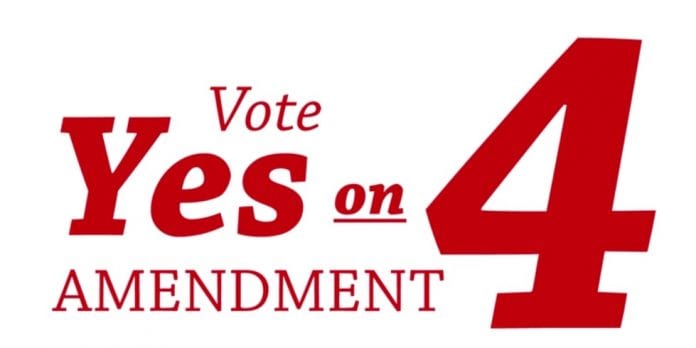
Among the 12 Constitutional Amendments on Florida’s ballot for the November 6 general elections, currently underway with early voting having begun on October 22, is Amendment 4 which is asking 60 percent of Florida voters to restore the voting rights of Floridians who served time in prison but were released.
Amendment 4 would restore voting rights to the 1.4 million Floridians who have felony convictions and have completed all aspects of their sentence including fines, probation or community service. It does not apply to people with convictions for murder or sexual offenses.
Florida is one of only four states in the country that permanently disenfranchises those with felony convictions. 75 percent of these 1.4 million people were never sentenced to prison. One third who are disenfranchised are African American. Our coalition includes people from all walks of life and all political persuasions from the Christian Coalition to local African American congregations to the Conference of Catholic Bishops. Studies show that people who have their voting rights restored are less likely to reoffend and that Amendment 4 will positively impact Florida’s economy by $365 million a year.

Support from entertainer John Legend
Recently American entertainer John Legend, one of the many Americans who support favorable passage of Amendment 4 said:
If it does pass, it will be historic. 1.5 million people getting their voting rights back will mean something bigger than anything that’s happened in voting rights since the civil-rights era.’’
For the benefit of Florida voters below is an overview of Amendment 4 as provided by Florida for a Fair Democracy.
Overview
People from all walks of life believe in forgiveness, redemption, restoration and, ultimately, Second Chances. We need to make sure that Florida law does, too:

- Florida’s system for restoring a person’s eligibility to vote is broken. Amendment 4 takes important steps toward fixing it.
- People must fully complete all terms of their sentence, including probation, parole or restitution, before they earn back their eligibility to vote.
- Amendment 4 doesn’t apply to individuals who’ve committed murder or a felony sexual offense.
Now is the time to restore the eligibility to vote to Floridians who have done their time and paid their debts.
Reasons to Support Amendment 4
Floridians believe in Second Chances and we need to make sure that Florida law does, too. Now is the time to return the eligibility to vote to Floridians who have done their time and paid their debts.
When a debt is paid, it’s paid.
- Nearly 1.4 million people in Florida, who have served their time and paid their debts, are permanently excluded from voting.
- Floridians who’ve paid their full debt – including parole, probation, and restitution – earned the opportunity to participate in and give back to their communities.
- This amendment would return the eligibility to vote to people only after they have completed their full sentences.
- The law specifically excludes those individuals who have committed murder or a felony sexual offense.
Florida’s system for restoring a person’s eligibility to vote is broken. Amendment 4 takes important steps toward fixing it.
- Current law outlines a difficult process to restore an individuals eligibility to vote because it requires the direct personal involvement of the Governor and the 3-person Cabinet, even after they have paid their debt.
- A judge recently determined that the restoration process is arbitrary and unconstitutional.
- It is arbitrary system, without any standardized guidelines in place to allow for objective and prudent decision making.
- The problem is that the judge left the fix in the hands of politicians and every election cycle newly elected politicians can reconfigure the process. A person’s eligibility to vote should not be left up to politicians and election cycles.
- Through the hard work of Florida voters and unwavering dedication of a truly grassroots movement, Amendment 4 was placed on the ballot. Let’s take matters into our own hands and VOTE YES on Amendment 4 to give Floridians, who have made past mistakes, the eligibility to vote only after they have completed their full debt. Amendment 4 doesn’t apply to people who’ve committed murder or a felony sexual offense.
- Florida is one of only four states with a lifetime ban on voting. The Amendment brings our state in line with others nationwide, including Texas, Georgia and South Carolina.
- Only Iowa and Kentucky have similar policies on the books, which permanently bar returning citizens from voting unless they get a pardon from the governor.
- In 46 states and the District of Columbia, most returning citizens gain the eligibility to vote upon the completion of their sentence.
-
- Currently, Florida law permanently excludes from voting 1.4 million Floridians who have paid their debt from voting for life.
- 1.4 million Floridians have fully completed their sentence and do not fall under the exclusion.
- According to annual Florida Court and Department of Corrections data, 75 percent of people convicted of felonies do not get sent to prison.
- Less than 30% are African Americans.
- In the last 5 years approximately 10,000 military veterans have fully completed their sentence and paid their full debt but still can’t vote due to Florida’s broken system.
- Currently, Florida law permanently excludes from voting 1.4 million Floridians who have paid their debt from voting for life.
- The total number of military veterans in Florida who have lost their eligibility to vote over the decades is much higher.
This matters to EVERYONE.
- Voters took matters in their own hands to ensure that their fellow Floridians, family members, and friends who’ve made past mistakes, served their time and paid their debts are given a second chance and the opportunity to earn back the eligibility to vote.
-
-
-
- People from all parties and all walks of life support Second Chances, including law enforcement, faith-based groups, families, businesses, and a large majority of Floridians.
- Second Chances is a non-partisan grassroots effort with bipartisan support.
- Second Chances is an organic, grassroots effort that transcends racial and party lines.
-
-
-
Recidivism
- Floridians from all walks of life support people being able to earn back the eligibility to vote because it gives them a stake in the community.
-
-
-
- Restoring a person’s eligibility to vote gives them an opportunity for redemption and a chance to be full members of their community.
- Studies by the Office of Offender Review show that people who earn the eligibility to vote are less likely to commit crimes in the future.
- According to the Florida Parole Commission, returning citizens whose civil rights are restored are three times less likely to re-offend than those who don’t.
- By helping people become responsible citizens, we create safer communities.
-
-
-
Economic Study
- A new economic study conducted by The Washington Economics Group (WEG) affirms that restoring the eligibility to vote for Floridians who have made past mistakes would result in positive economic impacts to Florida taxpayers totaling:
-
-
-
- An annual economic impact of $365 million
- Approximately 3,800 jobs annually
- An increase in annual household income of $151 million for Florida residents
-
-
-
Polling
-
- A September bipartisan poll conducted jointly by North Star Opinion Research and EMC Research shows that nearly 74% of Florida voters support Amendment 4.
- This amendment has the strong bipartisan support needed to pass with Florida’s 60 percent threshold regardless of party, gender, race, or region of the Sunshine State, Floridians strongly support Amendment 4.
- A September bipartisan poll conducted jointly by North Star Opinion Research and EMC Research shows that nearly 74% of Florida voters support Amendment 4.
- According to the survey, 59 percent of Republicans, 79 percent of Independents, and 88 percent of Democrats are in support.
- Amendment Four also receives support across various iterations of demographic subgroups. Over 60% of voters across the state, from the Panhandle to Miami, say they will vote yes.
In an added indication of the measure’s strength, there are very few undecided voters on the amendment. Only 3 percent of voters surveyed said they didn’t