Florida Atlantic University Harbor Branch Oceanographic Institute has received $2.8 million to establish a queen conch hatchery in Grand Bahama.

This support expands FAU Harbor Branch’s extensive aquaculture and food security program focused on replenishing queen conch populations throughout the Caribbean. It also enables the development of a conceptual master plan for a 25-acre innovation hub on Grand Bahama for researchers working to solve issues of island sustainability.
The project is built on a network of collaborations to secure local support and participation. FAU Harbor Branch will partner with the Bahamian community of Grand Bahama on a pilot-scale queen conch aquaculture farm led by Megan Davis, Ph.D., a research professor, FAU Harbor Branch Aquaculture and Stock Enhancement, and the world’s leading expert on queen conch aquaculture with 40 years of research in the field.

Prized for its iconic spiral shell and meat, the species is considered the cornerstone of the Bahamian culture and economy. Through partnerships, the project leads envision developing new economic and environmental opportunities for the community, along with helping to replenish queen conch populations.
“We’re extremely grateful to Builders Initiative for their generous support of our queen conch restoration efforts,” said FAU President Stacy Volnick. “FAU Harbor Branch’s work in aquaculture is helping to meet the growing global demand for food, thanks to partners like Builders Initiative who share our belief in sustainable solutions to environmental challenges.”
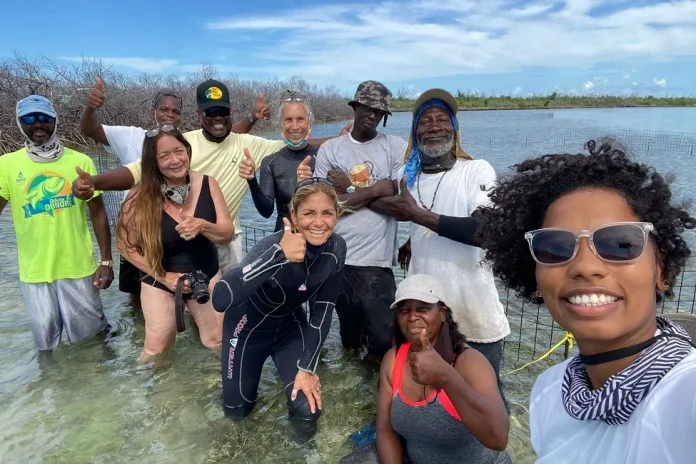
This summer, the project will begin with a mobile queen conch lab where scientists, with assistance from Bahamian staff and interns, will grow queen conch from their egg stage to juveniles. It will be located at Coral Vita, a commercial coral farm working to restore coral reefs, sharing resources with FAU Harbor Branch.

Blue Action Lab is a key strategic partner, assisting with permits, negotiations, and other collaborator relationships. Other partners include the Bahamas National Trust, the University of The Bahamas, the Perry Institute of Marine Science, and The Nature Conservancy, which will provide expertise on habitat mapping for conch breeding sites in seagrass beds.
“Having a hatchery operating in the community with full participation from the community will be a great way to not only increase knowledge and awareness of the life cycle of the conch, but it will also allow the opportunity to build relationships, technical skills, and solutions together,” said Catherine Booker, program coordinator with the Bahamas National Trust.
The project also will provide research internships for students at the University of The Bahamas and ecotourism opportunities.

Similar opportunities would come about through the 25-acre innovation hub. Known as Conservation Cove, it will be located on 25 acres on Grand Bahama. It is envisioned to include a tropical aquaculture park, an aquarium, a research and education hub, co-working spaces, and a hospitality center. FAU’s MetroLAB Design Collaborative, comprising FAU’s School of Architecture and Harbor Branch, will work with Blue Action Lab on the master plan.
The Grand Bahama queen conch hatchery is the fifth FAU partnership project to restore the queen conch throughout the Caribbean. FAU Harbor Branch has been working on restoration efforts since 2016 and has established other queen conch farms in Puerto Rico, Curacao, and Great Exuma, Bahamas.