A senior United States military official said the recent crisis in Europe will undoubtedly impact the Caribbean and other regions in the world, such as increasing energy prices and supply chain disruptions.

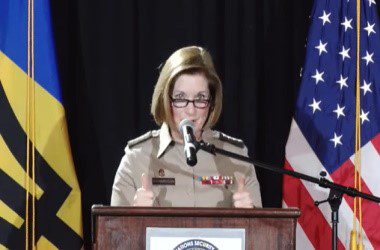
But the US Southern Command (SOUTHCOM) Commander U.S. Army General, Laura Richardson, said she is also aware that the Caribbean faces unique cross-cutting threats in an ever-changing security environment.
Addressing the opening of the two-day Caribbean Nations Security Conference (CANSEC), Richardson said with authoritarianism on the rise, protecting human rights, and helping democracies deliver for the people of the region is more important than ever before.

“We gather here at a critical moment in world history. Last month, the world witnessed Vladimir Putin start an unprovoked and horrific invasion of the sovereign nation of Ukraine. It was the most flagrant violation of the most fundamental principles the international community established after World War Two: self-determination and national sovereignty.”
Richardson said that for decades, Caribbean countries have long been champions of these sacred principles, adding that a threat to democracy anywhere, is a threat to democracy everywhere. “CARICOM added their voice to the chorus of peace-loving democracies around the world condemning Russia’s invasion and calling for an immediate ceasefire. This region truly is a “Zone of Peace,” as all CARICOM members so eloquently stated last month. What we’re doing right here at CANSEC is working together to keep the Caribbean a Zone of Peace.”
SOUTHCOM and the Barbados Defence Force (BDF) are co-hosting the two-day CANSEC that is being held under the theme “Multinational Cooperation in a Changing Operational Environment”.
According to a statement issued by the organizers, the aim of CANSEC is to promote regional and hemispheric security cooperation through expanding networks and to build enduring partnerships among military, industry and government officials.
Richardson told the conference that while the recent crisis in Europe will undoubtedly impact the Caribbean and other regions in the world, the region is also facing unique cross-cutting threats in an ever-changing security environment.
“Stronger hurricanes and rising sea levels caused by climate change are destroying lives and livelihoods, tearing up family homes and reversing decades of growth,” she said, adding that what’s worse, the poverty and job loss caused by natural disasters leave many people vulnerable to crime and violence.

She said women and children especially may fall victim to human trafficking.
But the SOUTHCOM Commander said one of the most imminent threats facing many countries are transnational criminal organizations (TCO) that are “poisoning the Caribbean and American people, trafficking in drugs, arms, humans, and other illicit products, and worsening corruption.
She said another emerging threat that can’t be ignored, is cyber-attacks, noting that “just last year, Microsoft reported that a China-based hacking group called Nickel conducted cyber-attacks against 29 countries, four of them in the Caribbean: Barbados, the Dominican Republic, Jamaica, and Trinidad and Tobago.
She said cyber crimes have only increased in the region since the pandemic, and we must do more together to defend ourselves in the cyber domain.
She said she was looking forward to reviewing the progress made from last year’s CANSEC, when “we focused on the impacts of the pandemic on force readiness, countering TCOs, and identifying coordination gaps within our regional response to humanitarian and natural disasters”.
CMC/