



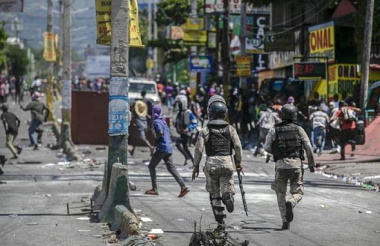
The Inter-American Commission on Human Rights (IACHR) has raised alarm over escalating gang-related violence in Haiti and reports indicating that recent law enforcement operations involving drones have resulted in civilian deaths, including children.
The Commission noted that operations conducted over the past year—some in collaboration with private actors—have allegedly caused multiple fatalities amid intensified security efforts.
A report from the Office of the United Nations High Commissioner for Human Rights (OHCHR) states that between March 2025 and January 2026, at least 5,519 people were killed and 2,608 injured, primarily in Port-au-Prince. According to verified OHCHR data, at least 1,424 people were killed and 790 injured in gang violence, while 3,497 were killed and 1,742 injured during security force operations against gangs. In addition, at least 598 people were killed and 76 injured in attacks carried out by civilian “self-defence groups.”

More recently, between March 28 and 29, 2026, gang-related violence in the Artibonite region left at least 70 people dead and around 30 injured. The report also referenced the kidnapping and killing of journalists Junior Célestin and Osnel Espérance in mid-March, as well as an armed attack against journalist Marvel Dandin.
In response to widespread violence, state security operations have reportedly included the use of drones and helicopter fire. Information from the United Nations Integrated Office in Haiti (BINUH) and civil society organizations indicates that these operations have resulted in at least 60 deaths and 49 injuries among individuals reportedly not affiliated with gangs, including 13 children killed and 10 injured. An OHCHR report dated March 24, 2026, further states that some drone strikes were carried out by national law enforcement with support from a foreign private military contractor.
In its response, the State said that these operations are conducted in areas currently under the control of criminal groups, following prior identification of targets and with safeguards intended to minimize collateral harm.
The IACHR acknowledged the State’s responsibility to protect its population from gang violence and maintain public order, as well as its efforts to address the crisis. However, the Commission stressed that in the absence of a clear legal classification of armed conflict, state actions remain subject to international human rights law. It added that all alleged deaths, including those resulting from such operations, must be promptly investigated as potential arbitrary deprivations of life.
The Commission expressed particular concern over the deaths of children, noting that they occur amid increasing recruitment and use of minors by gangs in Haiti. It also highlighted risks to press freedom, stating that as criminal groups expand territorial control, kidnappings and short-term enforced disappearances are silencing journalists and enabling censorship and further crimes.
The IACHR further emphasized that the involvement of private actors in security operations must fully comply with international human rights standards, including legality, necessity, proportionality, and accountability. It urged respect for the right to life, noting that such operations require a human rights-based approach and due diligence, in line with Resolution No. 01/26.
The Commission reaffirmed its commitment to monitoring the situation in Haiti and supporting victims and affected communities through its mechanisms. It called for strengthened protective measures, greater transparency in security operations, and continued adherence to international standards to reduce risks to the population.
The Inter-American Commission on Human Rights (IACHR) is an autonomous body of the Organization of American States (OAS), mandated to promote and protect human rights in the region. It is composed of seven independent members elected by the OAS General Assembly, serving in their personal capacity.





 has raised alarm over escalating gang-related violence in Haiti.)