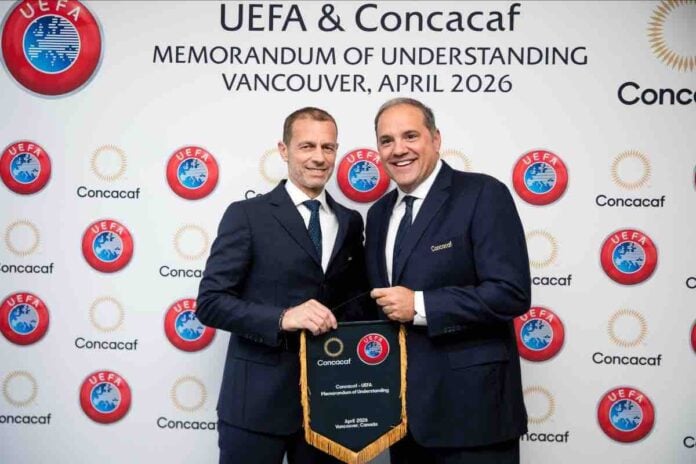
Football’s global development landscape entered a new phase on Wednesday as two of its most influential confederations formally committed to closer cooperation.

In a landmark moment for the sport, UEFA and Concacaf signed a renewed memorandum of understanding (MoU) designed to strengthen collaboration across player development, coaching education, refereeing standards, and football administration.
The agreement was finalized in Vancouver, Canada, on the margins of the 76th FIFA Congress, where UEFA President Aleksander Čeferin and Concacaf President Victor Montagliani formally sealed the partnership.

Running through June 2031, the agreement establishes a structured yet flexible framework aimed at deepening ties between Europe and the Confederation of North, Central America and Caribbean Association Football.
A shared vision for football’s future
At the heart of the agreement is a simple but ambitious idea: football development improves when regions learn from one another.
For UEFA, that means engaging with one of the sport’s fastest-growing and most culturally diverse regions. For Concacaf, it represents access to established European systems and elite-level structures that can help accelerate long-term growth.
Čeferin emphasized the importance of bridging football cultures across continents.
“Europe and the Concacaf region are home to some of the world’s most diverse football cultures, from deep-rooted traditions to fast-growing, innovative environments,” he said.
“By connecting these experiences, we can strengthen development pathways, raise standards and offer new opportunities throughout the game.”
Youth football at the center of exchange
One of the most significant components of the agreement focuses on youth development.

Under the new framework, UEFA will extend invitations to boys’ and girls’ youth national teams from Concacaf member associations to participate in selected European youth tournaments.
The initiative is designed to expose young players to higher levels of competition while also encouraging cultural exchange and football education beyond national borders.
For many emerging players, the opportunity represents a rare chance to measure themselves against Europe’s elite youth systems in competitive environments.
Expanding knowledge through collaboration
The MoU also introduces a series of reciprocal exchange programs aimed at strengthening institutional knowledge across both confederations.
These include observer roles at major club finals and international tournaments, allowing officials and administrators to study best practices in event delivery, competition management, and match operations.
Additional areas of cooperation include club licensing standards and regulatory frameworks, joint coach education initiatives, and exploratory discussions on mutual recognition of coaching qualifications.
The goal is to gradually align standards while respecting the distinct identities of each football region.
Refereeing and technical development take priority
Match officials are also central to the agreement.
Referees and technical instructors from UEFA and Concacaf will participate in joint development programs, youth tournaments, and educational courses aimed at raising officiating standards on both sides of the Atlantic.
In a notable step forward, FIFA-listed referees could also be deployed across confederation lines, gaining experience in each other’s competitions and broadening their exposure to different styles of play.
The initiative is expected to enhance consistency, decision-making, and professional development among elite officials.
“UEFA Together” expands global reach
A key pillar supporting the agreement is UEFA’s “UEFA Together” programme, which will now be used to facilitate long-term, customized development projects between member associations from both confederations.
The initiative is designed to move beyond short-term exchanges and instead foster sustained partnerships between federations with shared goals.
Regular high-level strategic meetings will also be held to monitor progress, refine initiatives, and ensure that cooperation remains active and impactful over time.
Concacaf highlights a decade of progress
From the Concacaf perspective, the agreement is both a recognition of progress and a platform for continued advancement.
Montagliani highlighted the importance of collaboration in sustaining growth across the region.
“Football is at its best when it brings people together, creates opportunity, and helps our global communities grow,” he said.
“Concacaf has made tremendous progress over the past decade, and partnerships like this help us continue raising standards while staying true to our responsibility to serve the game at every level.”
A partnership built for the long game
While the agreement includes immediate exchange programs and technical cooperation, its broader significance lies in its long-term vision.
By linking Europe’s established football infrastructure with Concacaf’s rapidly evolving landscape, the two confederations are positioning themselves to jointly shape the next generation of global football development.
As the partnership begins its eight-year journey, both sides appear aligned on a shared objective: building a more connected, competitive, and collaborative football world.