Inside Estadio Akron, the silence from one half of the stadium told the story long before the scoreboard confirmed it.

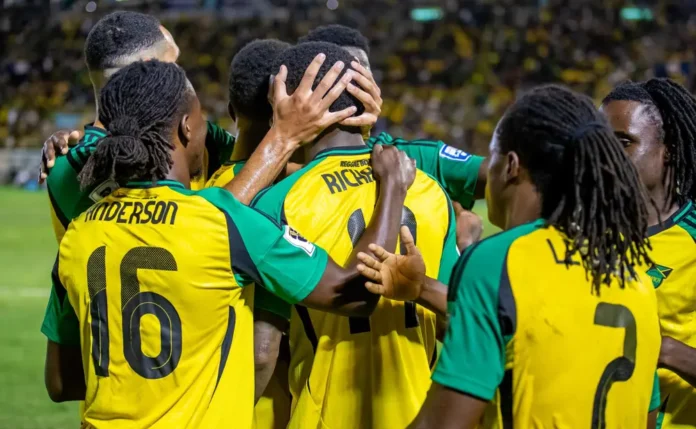
The Reggae Boyz, Jamaica’s national football team, had come within touching distance of the 2026 FIFA World Cup, only to see that dream dissolve in the most unforgiving manner.
A single goal in extra time handed the DR Congo national football team a 1-0 victory, ending Jamaica’s campaign and extending a World Cup drought that now stretches beyond a generation.

The decisive moment
For 100 minutes, the contest teetered on a knife-edge.
Then came the lapse.
From an in-swinging corner early in extra time, Axel Tuanzebe reacted quickest, redirecting the ball past captain Andre Blake to deliver the only goal of the match, and with it, a place in football history for DR Congo.

It ended a 52-year wait for the nation, which participated in the 1974 edition of the World Cup as Zaire.
Jamaica’s players stood momentarily frozen, the consequence of a single breakdown in concentration proving irreversible.
Interim Head Coach Rudolph Speid, whose contract ended at the final whistle, did not hesitate to identify the turning point.

“I think we lost concentration on a setplay and I think that made the difference between winning and losing… The players gave 100 per cent… we tried our best.”
A game of margins, a lack of ideas
Despite moments of promise, Jamaica’s attacking efforts rarely translated into sustained threat.
Statistically, they held a slight edge in possession, yet over 120 minutes, they produced just one effort on target, a telling indicator of a performance that lacked cutting edge.
More critically, there was little evidence of tactical adjustment when the game demanded it. There was no imagination, no meaningful intervention from the sidelines to alter the rhythm or unlock the Congolese defense. In a must-win scenario, the response remained predictable, dour, and ultimately insufficient.
Even as the match drifted toward extra time, Jamaica struggled to generate the kind of decisive moment required to seize control.
Early exchanges and missed chances
DR Congo signaled their intent early.
Cedric Bakambu and Meschack Elia both threatened, testing Jamaica’s defensive organization in the opening stages.
Jamaica’s clearest first-half opportunity fell to Kasey Palmer, whose goal-bound effort was deflected wide, while Leon Bailey fired narrowly off target from distance.
At the other end, Blake was called into action, producing a crucial save to deny Elia and later delivering a spectacular stop early in the second half to keep Bakambu at bay.
Around the hour mark, Jamaica enjoyed their most promising spell.
A succession of corners pinned DR Congo deep, forcing hurried clearances and creating the sense that a breakthrough might come. That moment passed, and with it, Jamaica’s momentum.
DR Congo regrouped, nearly finding the net twice, only for offside decisions to intervene.
Extra time collapse
The warning signs were there.
Within minutes of extra time, DR Congo created another opening before finally capitalizing through Tuanzebe’s decisive intervention.
Though there were brief late surges, most notably through substitute Renaldo Cephas, Jamaica never truly threatened a response.
A late miss by Edo Kayembe spared further damage, but the outcome had already been sealed.
Captain Blake, visibly emotional, summed up the mood within the camp.
“We’re very sorry we weren’t able to deliver… I thought we gave them a tough game… but we just came up short.”
Speid echoed the sentiment:
“All of us, players and coaching, tried our best… we got a few opportunities but it wasn’t to be.”
A dream delayed again
For Jamaica, the result extends a painful narrative.
Their last World Cup appearance was in 1998, and despite optimism entering this cycle, the breakthrough never came. This latest setback, following earlier qualification disappointment, only deepens the frustration.
DR Congo, by contrast, celebrates a historic return to the global stage for the first time in 52 years, advancing to face Portugal, Colombia, and Uzbekistan in Group K.
Attention now shifts to the future, both immediate and long-term.
The leadership question looms, with Speid’s interim tenure concluded, while players return to their respective clubs carrying the weight of what might have been.
Blake, however, urged perspective:
“I’m going to tell them to keep their heads up… it’s a very tough time… but hopefully we can build on this and look forward to the next one.”
Teams: Jamaica – Andre Blake, Ethon Pinnock, Richard King, Ronaldo Webster (Amari’i Bell 90th), Joel Latibeaudierre, Isaac Hayden (Ian Fray 83rd), Bobby Reid (Tyrese Hall 83rd), Kasey Palmer (Norman Campbell 91st), Leon Bailey, Tyreece Campbell (Ephron Mason-Clark 74th), Bailey Cadamarteri (Renaldo Cephas 74th)
Booked: Webster (35th), Cadamarteri (63rd)
Subs not used: Amal Knight, Jahmali Waite, Damion Lowe, Andre Brooks, Dwight Merrick, Jamal Lowe
DR Congo – Lionel Mpasi-Nzau, Aaron Wan-Bissaka, Chancel Mbemba, Axel Tuanzebe, Arthur Masuaku (Joris Kayembe Ditu 106th), Meschack Elia (Theo Bongonda 58th), Samuel Moutoussamy (Charles Pickel 120th), Noah Sadiki (Ngal Ayel Mukau 73rd), Nathanael Mbuku (Edo Kayembe 67th), Yoane Wissa (Brian Cipenga 91st), Cedric Bakambu
Booked: None
Subs not used: Matthieu Epolo, Timothy Fayulu, Rocky Bushiri, Steve Kapuadi, Fiston Mayele, Simon Banza
Referee: Facundo Tello (Argentina, substituted due to injury in the 114th)
Assistant Referees: Juan Pablo Belatti, Gabriel Chade (Argentina)
Fourth Official: Dario Herrera (Argentina)
VAR: Hernan Mastrangelo (Argentina)
AVAR: Juan Soto (Venezuela)