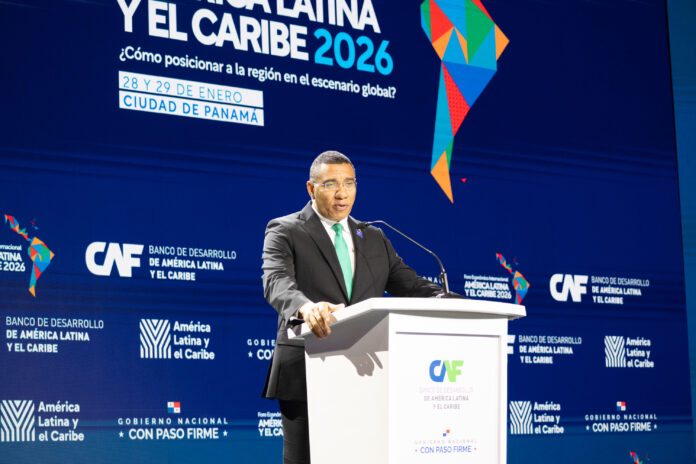
Jamaica’s Prime Minister, Andrew Holness, on Wednesday called on Latin America and the Caribbean to position itself more assertively as a central force in the global economy, urging the region to move beyond what he described as a long-standing narrative of vulnerability.

Speaking at the opening ceremony of CAF’s second International Economic Forum in Panama City, Holness told an audience of regional and international leaders, policymakers, investors, and development partners that the region faces a defining choice: to shape global change or be shaped by it.
“For too long, our region has been described primarily through the language of vulnerability,” Prime Minister Holness said. “But vulnerability is not destiny. We are not peripheral to the global system; we are central to its stability, sustainability, and future growth.”

Holness pointed to Latin America and the Caribbean’s strategic geography, youthful populations, natural resources, food-producing capacity, renewable energy potential, creative industries, and resilient democratic institutions as key strengths. He said harnessing these advantages requires stronger regional coordination and clearer alignment on shared priorities.
“We must articulate clearer regional positions on climate resilience, supply-chain diversification, digital inclusion, and sustainable energy,” he stated. “We must move from fragmented national initiatives to aligned regional priorities. And we must shift from reacting to global change to anticipating it, helping shape the standards and partnerships of the next decade.”
The Jamaican leader outlined three imperatives to advance the region’s economic standing: a competitiveness agenda focused on connectivity, logistics, energy security, and digital transformation; institutional readiness grounded in credible and predictable frameworks; and a renewed diplomatic and economic posture that deepens engagement with both traditional partners and emerging markets.

Drawing on Jamaica’s experience, Holness said sustained fiscal discipline, institutional reform, and macroeconomic stability have strengthened the country’s ability to absorb shocks and recover from crises. He cited Jamaica’s response to Hurricane Melissa—a Category Five storm that struck months ago and caused significant damage and economic losses—as an example of resilience supported by strong institutions and continued international confidence.
Holness also used the forum to invite investors and development partners to engage with Jamaica’s expanding pipeline of bankable projects in sectors including infrastructure, logistics, energy, manufacturing, tourism, and the digital economy. He encouraged participants to see Jamaica not just as a market, but as a platform for regional growth, supported by macroeconomic stability and a predictable, investor-friendly environment.
As part of the forum’s programme, CAF has organized a Jamaica Investment Forum in collaboration with the Government of Jamaica, aimed at attracting investment to support the island’s rebuilding drive.