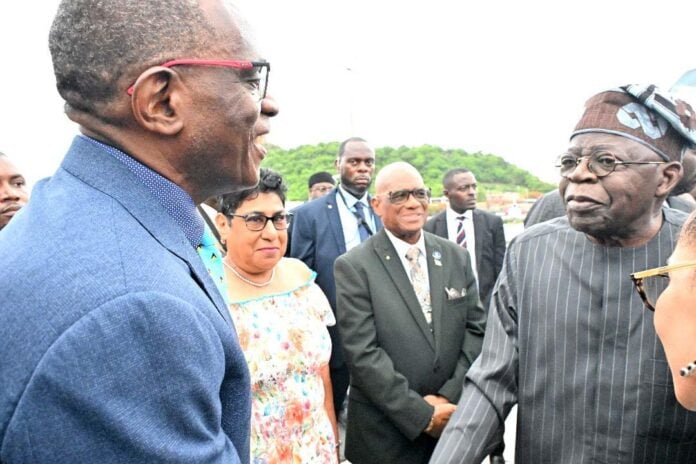
The Nigerian President Bola Tinubu’s ongoing state visit to Saint Lucia has been described as a landmark diplomatic and cultural mission aimed at strengthening ancestral ties and forging strategic partnerships with the Caribbean nation and the broader CARICOM bloc.

In a statement released Sunday and signed by Special Adviser to the President on Information and Strategy, Bayo Onanuga, the Presidency dismissed criticism of the visit as “misguided, mischievous, and uninformed,” while emphasizing the significance of the engagement.
“First, from the perspective of the Government of Saint Lucia, the visit by the Nigerian leader paves the way for the rekindling of our ancestral bonds, igniting a new era of diplomatic, cultural, and economic possibilities between our nations,” the statement read.

Highlighting Saint Lucia’s historical ties to Nigeria, the Presidency noted that a wave of immigrants from present-day Nigeria arrived on the island in the mid-19th century, bringing cultural and religious practices that still influence local traditions. Onanuga said citizens of Saint Lucia are enthusiastic about President Tinubu’s visit and are eager to deepen connections with Africa.
The Presidency also framed the visit as a key part of Nigeria’s South-South cooperation agenda and its Four D’s foreign policy strategy — Democracy, Development, Diaspora, and Demography.
“Saint Lucia is the headquarters of the Organisation of Eastern Caribbean States and the gateway to the 15 CARICOM member states,” the statement noted. “The CARICOM states have a combined GDP of over $130 billion, a significant figure in South-South trade discourse.”
Citing historical diplomatic links, the Presidency recalled the contributions of Saint Lucian-born Sir Darnley Alexander, who served as Chief Justice of Nigeria from 1975 to 1979. Alexander had arrived in Nigeria in 1957 as a legal draftsman for the Western Regional Government under Chief Obafemi Awolowo. He went on to serve in various key legal roles, eventually becoming Chief Justice after appointments as Solicitor General, Lagos High Court judge, and Chief Judge of the former South Eastern State.
Other Saint Lucians have also contributed to Nigeria’s development, including architect Neville Skeete, who helped design the Central Bank of Nigeria headquarters, and Sir Darnley’s son Michael, who was a frontline medical officer during the Nigerian Civil War.
Culturally, the Presidency said Tinubu’s visit aligns with the African Union’s Sixth Region agenda, which recognizes the African diaspora as an integral development partner. It pointed to growing Nigerian cultural influence in Saint Lucia, particularly through music and film.

“Our cultural exports, including Afrobeats, Nollywood, and literature, are already making a significant impact on Saint Lucia and the wider Caribbean,” the statement said, adding that Nigerian music dominated the popular Gros Islet Street Party just before Tinubu’s arrival — a symbol of Nigeria’s “growing soft power and cultural footprint.”
The Presidency also underscored shared democratic values between the two countries. “Saint Lucia is a stable parliamentary democracy, making it a natural ally for Nigeria, which has enjoyed 26 years of uninterrupted democratic governance,” the statement said, noting that a local commentator described Tinubu as a “fighter for democracy” during the live broadcast of his arrival.
The visit also touches on Nigeria’s demographic importance, with Onanuga reiterating President Tinubu’s focus on leveraging the nation’s growing youth population for economic transformation through education, industrialisation, and innovation. Nigeria is projected to become the world’s third most populous country by 2050.
As part of his itinerary, Tinubu will visit the Sir Arthur Lewis Community College to explore educational partnerships. The Nigerian delegation also includes members of the Nigerian Technical Aid Corps, who are deployed to ACP (African, Caribbean and Pacific) countries to offer professional services.
“This assistance is delivered through the deployment of Nigerian professionals to recipient countries to address specific needs,” Onanuga explained.
Saint Lucia’s Prime Minister is also expected to host a reception for the Nigerian community, providing an opportunity for direct engagement with the President and his delegation.
Saint Lucia, which gained independence in 1979, has hosted fewer than ten official state visits. The last visit by an African leader was that of South Africa’s Nelson Mandela in 1998 during the 19th CARICOM Heads of Government Summit.