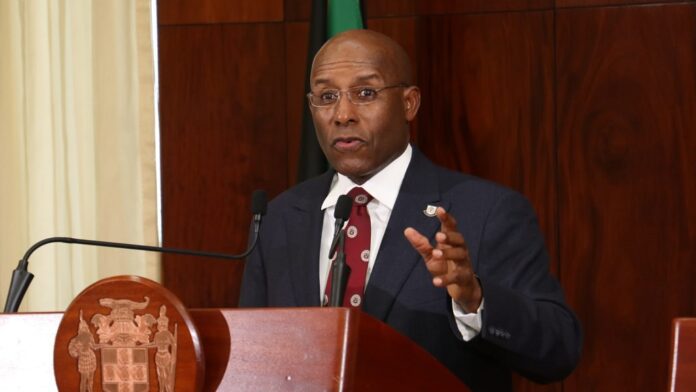
Jamaica’s Minister of Industry, Investment, and Commerce, Aubyn Hill, is once again calling on banks to lower their interest rates on loans, arguing that high borrowing costs are stifling economic growth.
Despite the Bank of Jamaica (BOJ) reducing its policy rate four times between August and December 2024, commercial banks have yet to follow suit.
“We want our banks to be profitable. When you have a growing economy, banks benefit most [as] there are more transactions being done. [But] in order to have a growing economy, you must have reasonable and reasonably low interest rate,” Hill said during Monday’s signing ceremony for a memorandum of understanding (MOU) between the Caribbean Export Development Agency (CEDA) and the Development Bank of Jamaica (DBJ). “When the central bank has been cutting its lending rate, we need to see the banks move in that direction,” he added.

The concern over high lending rates is particularly significant for micro, small, and medium-sized enterprises (MSMEs), which form the backbone of Jamaica’s economy. MSMEs account for 97% of Jamaican businesses, employ 80% of the workforce, and contribute 44% of the country’s GDP. Yet, access to affordable financing remains a persistent challenge.
A competitive disadvantage for the diaspora
Jamaica’s lending rates remain significantly higher than those in the United States, where mortgage and auto loan interest rates are considerably lower. For example, while mortgage rates in the U.S. currently range between 6-7%, Jamaican borrowers often face rates exceeding 8-10%—sometimes higher depending on the financial institution. Car loans in Jamaica can carry double-digit interest rates, compared to U.S. rates that are typically in the 5-8% range.
This discrepancy creates a barrier for Jamaicans abroad who may be considering investing in property or business ventures back home. Many members of the diaspora find it more financially viable to borrow in the U.S. or Canada, rather than take on the high cost of borrowing in Jamaica.

High interest rates also slow down local business expansion, making it difficult for entrepreneurs—especially in tech and manufacturing—to access the capital needed to scale. This is one of the reasons why programs like the DBJ’s Boosting Innovation, Growth, and Entrepreneurship Ecosystems (BIGEE) initiative, funded by the Inter-American Development Bank (IDB), are so critical. The newly announced partnership between CEDA and DBJ will introduce a grant-funding program to support local tech entrepreneurs who secure corporate partnerships, with funding of up to US$75,000 per innovator.
As global investors and members of the diaspora evaluate their options, Jamaica’s high interest rates continue to be a major factor in investment decisions. Until lending institutions lower rates in line with BOJ’s policy shifts, the country may struggle to attract the level of business expansion and foreign capital needed to sustain long-term economic growth.