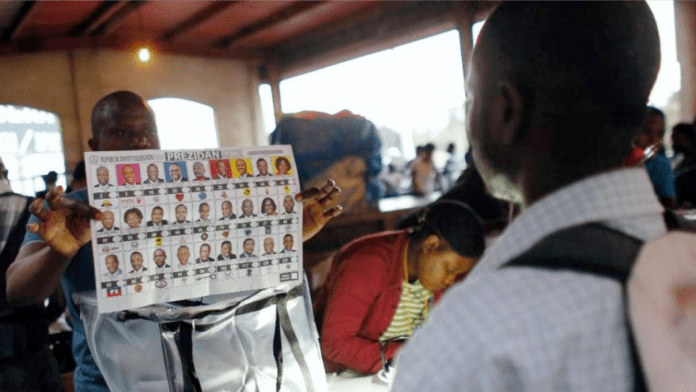
The head of Haiti’s Presidential Transitional Council (TPC), Leslie Voltaire, has announced that general elections will take place in November 2025, as the country moves toward restoring democratic governance after years of political instability.

“We must hand over power to a legitimate, elected government on February 7, 2026,” Voltaire told TV5 Monde, indicating that the elections are expected to be held around November 15, 2025.
Haiti has not had elected representatives since January 2023 and last held elections in 2016. However, widespread gang violence and political turmoil continue to pose serious challenges to the electoral process.

Armed gangs have taken control of significant portions of the capital, Port-au-Prince, with many openly attempting to overthrow the government. The United Nations estimates that more than one million Haitians have been internally displaced due to the ongoing violence.
The gangs’ activities have also led to frequent closures of major ports, further exacerbating an already dire humanitarian crisis. According to officials, more than five million Haitians—nearly half the population—are facing severe food insecurity as a result.
Haitian authorities have repeatedly stated that security must be restored before elections can take place. In his interview, Voltaire said he had met with French President Emmanuel Macron, who pledged France’s support in improving Haiti’s security situation and combating drug trafficking.

Haiti government vows crackdown on gangs
Meanwhile, Haitian Prime Minister Alix Didier Fils Aimé held a high-level meeting at the General Directorate of the National Police of Haiti (DGPNH), reaffirming the government’s commitment to crushing criminal networks.
“The State will not back down,” Fils Aimé declared. “It is imperative to restore trust, strengthen coordination between law enforcement agencies, and neutralize those who sow terror.”
The prime minister condemned the surge in violence, saying “too many families are mourning loved ones, too many women have been raped, and too many workers are unable to earn a living.”

“The State is rising up! The State is striking! The State will triumph!” he added.
Following the meeting—which included Justice Minister Patrick Pélissier, Interior Minister Paul Antoine Bien-Aimé, and Secretary of State for Public Security Mario Andrésol—officials announced an intensified crackdown on gang-controlled areas.
Reinforced security operations
A statement issued after the meeting outlined a multi-pronged security strategy, including:
- Increased police operations targeting high-crime areas
- Additional personnel and equipment for security forces
- Stronger coordination between the Haitian National Police (PNH) and the Haitian Armed Forces (FAd’H)
- Targeted actions against gang leaders and criminal networks
“The police will receive the necessary resources to track down, dismantle, and neutralize armed groups,” the statement read. “Fear must change sides—criminals will no longer terrorize the population.”
Prime Minister Fils Aimé vowed to eliminate criminal elements, urging Haitians to support the government’s efforts.
“We will strike hard and relentlessly. No criminal will be spared,” he declared. “This fight belongs to the entire nation.”
“We must stand united and resolute. Every Haitian must collaborate with law enforcement and reject any form of complicity with those destroying our country.”
As Haiti prepares for elections, its leaders face the dual challenge of restoring security and ensuring a credible electoral process.
“We have a clear mandate: to end the reign of criminals,” Fils Aimé emphasized. “And we will do it—without hesitation, with the full strength and authority of the state.”
“The enemy will be defeated. Order will be restored. Haiti will find peace again.”