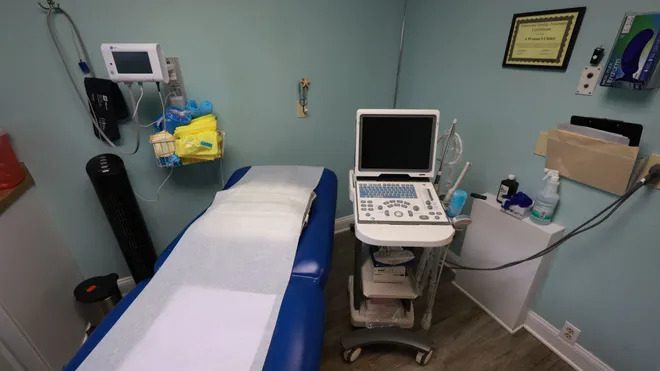
Florida implemented a ban on abortions after six weeks of pregnancy, commencing just after midnight on Wednesday.

Prior to this, the state served as a haven for abortion access in the Southern region subsequent to the Supreme Court’s overturning of Roe v. Wade.
Initially, Florida restricted abortions after 15 weeks in 2022; however, neighboring states imposed even stricter regulations, prompting over 9,300 individuals to seek abortion care here last year, more than double the number in 2020, according to data from the Guttmacher Institute, a pro-abortion access research organization.

Approximately 84,000 abortions were conducted in Florida last year, constituting about 1 in 12 nationwide.
The new law in Florida aims to reverse this trend by criminalizing the performance or active participation in an abortion after six weeks of gestation, roughly two weeks post a missed period. Exceptions are granted for cases of rape, incest, and human trafficking up to 15 weeks into pregnancy. While state law permits abortions to safeguard a woman’s life or prevent “substantial and irreversible” physical impairment, concerns regarding legal liability may still linger among healthcare providers.
Confusion about the restrictions
Abortion providers in Florida made concerted efforts to accommodate as many patients as possible in the weeks leading up to the ban’s enforcement. However, some patients encountered confusion regarding the state’s restrictions and timelines, particularly since Governor Ron DeSantis signed the six-week ban approximately a year ago. The policy had been temporarily halted pending a state Supreme Court ruling last month, which ultimately paved the way for its enactment.

Furthermore, Florida mandates two in-person visits to a clinic, spaced 24 hours apart, before undergoing an abortion—a requirement that some patients may be unaware of.
With nine Southern states enforcing total abortion bans and others like Georgia and South Carolina restricting abortions after approximately six weeks, individuals in Florida and neighboring Southeastern states seeking pregnancy termination may now find their nearest options in North Carolina, where abortions are permitted up to 15 weeks, and Virginia.
The Florida Access Network, a fund aiding individuals in Florida with abortion-related expenses—including appointments, sustenance, and travel—is prepared for an influx of patients seeking assistance with out-of-state abortions.

Read: Florida Supreme Court greenlights abortion rights and marijuana legalization for voter consideration