


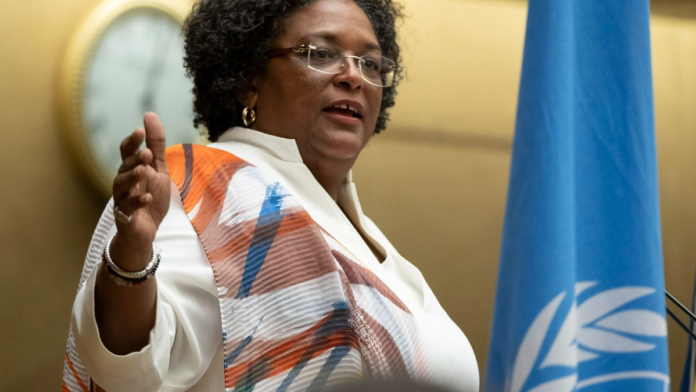
BRIDGETOWN, Barbados – In a candid statement that has stirred conversations across the Caribbean cricket community, Prime Minister Mia Mottley emphasized that Barbados will no longer depend solely on Cricket West Indies (CWI) to secure cricketing opportunities for the island.

Her remarks come on the heels of CWI’s controversial decision to exclude the iconic Kensington Oval from hosting any regional or international fixtures in 2026.
Kensington Oval misses out, sparks controversy
Kensington Oval, affectionately known as “The Mecca” of West Indies cricket, will see none of the marquee matches scheduled for the upcoming home series against Sri Lanka, New Zealand, and Pakistan.

A total of four Tests, six One Day Internationals, and six T20 Internationals, slated between June and August, will instead be staged across Jamaica, Antigua, Trinidad and Tobago, and Guyana.
The move has ignited criticism in Barbados. Both Calvin Hope, president of the Barbados Cricket Association (BCA), and the chairman of Kensington Oval Management Inc (KOMI) voiced their disapproval of CWI’s decision.
Barbados takes matters into its own hands
Mottley framed the exclusion as an opportunity for Barbados to broaden its cricketing reach beyond traditional governance.

“It was clear to us that we could not only rely on Cricket West Indies for cricket in this country,” Mottley said, “and that is why we made a deliberate decision to go after the CPL finals here and to be also able to see what else we can do to boost the opportunities for Bajans in the entire game of cricket, not just as players, but as umpires and as persons who are involved in the ecosystem period.”
By securing the Caribbean Premier League (CPL) finals at Kensington Oval, Barbados aims to create a platform not just for players but for the full spectrum of cricketing professionals.
Beyond players: A broader vision for cricket in Barbados
Mottley’s comments underscore a strategic push for cricket development across the island. She envisions a more inclusive ecosystem, providing opportunities for officials, support staff, and administrators, rather than relying solely on matches sanctioned by CWI.

Her position signals a shift toward greater autonomy in Barbados’ cricketing future, one that balances tradition with proactive initiatives to sustain and grow the game locally.











 to secure cricketing opportunities.)