Religious signs may soon have no place in Broward County Public Schools, as the district grapples with a heated debate over its policy on school fence banners.
What began as a routine display of sponsorship banners has ignited a firestorm of legal challenges and public outcry, pitting religious groups against one another and prompting the school board to reconsider its policies.
The controversy emerged after Chaz Stevens, a Deerfield Beach activist and founder of the ‘Church of Satanology,’ asked school officials if he could hang a banner promoting his group outside Marjory Stoneman Douglas High School. His banner proposal included the phrase “Satan is here for the pick sixes.” Stevens said it should not have been an issue since there was already a banner outside the school advertising a local church.

District officials eventually responded, and said the church sign would come down: “Based on the district’s advertising policy, the banner has been removed.”
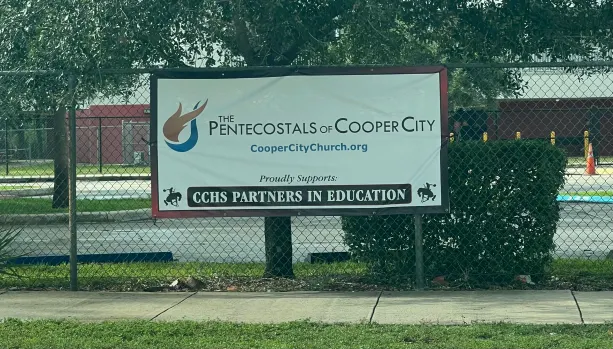
A similar issue occurred when Pentecostals of Cooper City had their banner removed from Cooper City High School, despite paying for a one-year sponsorship.
Rev. Paul Volan, the church’s pastor, voiced frustration at a recent school board meeting, claiming the removal undermined their support for the school and their financial investment. The church had adhered to the district’s rules, including paying $1,200 for the right to display the banner. The banner was up from February 2023 until December 2023 when it was removed “due to a complaint.” The school board never mentioned who or where the complaint came from.

Other religious banners (those advertising Christian churches or values) continued to hang at various schools across Broward throughout the year. Stevens, meanwhile, attempted to secure advertising space at other Broward Schools — those requests were ignored or denied.
The controversy became a legal matter when Stevens’ group filed a lawsuit against the district in September. In the lawsuit, Stevens argued that the district’s selective policy undermined his ability to practice his religion in the same manner as other religious groups.
“The exclusion of my banner while allowing Christian banners is a blatant violation of my First Amendment rights,” Stevens stated. “If public schools are going to open their doors to religious messages, they must allow all religious viewpoints—whether they agree with them or not.”

The legal dispute has forced the Broward County School District into a difficult position. While the district maintains that its policy prohibits religious advertisements of any kind, the fact that religious signs were allowed to remain up at various schools points to inconsistent enforcement.
School officials have acknowledged the issue but argued that the isolated instances of religious banners being displayed were not part of a widespread or intentional practice. They pointed to these cases as mistakes, with the banners removed once the problem was brought to their attention.
However, the controversy has brought increased scrutiny to the district’s practices, with critics arguing that its policies on religious expression were neither clear nor fairly enforced.
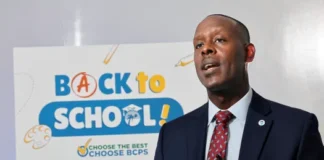
In an attempt to address the growing tension, Superintendent Howard Hepburn suggested that the district might revisit its policies on school banners. At a recent meeting, Hepburn requested the Pentecostals give the district 90 days to update its regulations, an offer that Volan rejected, frustrated by the lack of communication and resolution.
In the wake of these challenges, Broward County Public Schools announced that it would review potential changes to its banner policy in a workshop scheduled for December 10, 2024. According to Sun Sentinel, the district is considering a full ban on the display of religious signage on school fences, which would align it with policies in other districts, such as Palm Beach County, that explicitly prohibit religious advertising.
Critics of such a move argue that the district would be infringing on free speech by banning religious groups from advertising if non-religious groups are still allowed to do so. On the other hand, some legal experts believe the district is attempting to avoid the appearance of favoring one religious viewpoint over others, which could lead to further legal complications.
The changes in Broward County come at a time when religious expression in public spaces, especially in schools, is a hot-button issue across the United States. As the debate continues, the outcome in Broward County could set a precedent for how other school districts handle similar situations in the future.