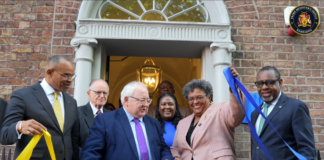
Jamaica has launched a multibillion-dollar ship repair and maintenance facility that will provide dry docking for commercial vessels up to 20,000 tons, and a range of maintenance and repair services to vessels operating in and around the Caribbean and Central America.

Prime Minister Andrew Holness said the German Ship Repair Jamaica (GSRJ) Shipyard at the Kingston Harbour along the Sir Florizel Glasspole Highway, will earn foreign exchange for the country.
“It will provide high-quality jobs, and it will contribute greatly to the prosperity of our country,” he added.

Phase one of the project, which is to be completed by November is being undertaken at an overall cost of nearly US$37 million, with financial partner Sagicor Bank committing to half of the amount as a bank loan. The GSRJ’s partners include Harren and Partner Group, Germany; Kingston Holding, Jamaica; Kloska Group, Germany and HAT-SAN Shipyard, Turkey.
Prime Minister Holness said the development will contribute to the positioning of Kingston Harbour as a global logistics hub, noting that each year, Jamaica receives approximately 3,000 port calls while approximately 180,000 vessels operate within the region.
“With the investments that are being made in improving Kingston as a logistic hub, we are certain that we have now closed one of the major gaps that have existed and that more ships passing through the region will be inclined to come to Jamaica,” he said.

GSRJ Limited Chief Executive Officer, Colonel Martin Rickman, said the project “represents a new industry for Jamaica with great opportunities for other spin-off businesses, hence even contributing more to the economy”.
He said Jamaica’s “excellent geo-strategic location” makes the country particularly suitable for having a shipyard, adding “we here at GSRJ Shipyard will be able to lift that ship out of the water to conduct many types of work on the hull, the propeller, engine repairs and the entire nine yards, so this is significant for us”.
Under international maritime law, all ships are required to be dry-docked to check for safety and integrity once every five years and attain class certification.

Rickman said the training component of the project is crucial to enable workers to meet the international standards to carry out the required operations.
CMC/