Suriname is observing its 49th anniversary of political independence from the Netherlands with both the coalition government and the opposition giving differing views on the socio-economic development of the Dutch-speaking Caribbean Community (CARICOM) country.
In a statement, the Progressive Reform Party (VHP) of President Chandrikapersad “Chan” Santokhi, said the coalition government has significantly improved the relations between Suriname and The Netherlands which had become increasingly worse after the coup of 1980 by former military strongman, Desi Bouterse.
“Fortunately, after the inauguration of the Santokhi government in 2020, a turnaround has occurred in the relationship between Suriname and the Netherlands.

“The diaspora community has an extraordinary value for Suriname in economic, social, cultural and educational areas, among others.
“Both countries have an immense bond with each other. Politically, the relationship between both countries is good. We are now two equal countries and sovereignty is the symbol of national independence.
“With oil & gas production in 2028, Suriname is taking big steps forward. We are at the crossroads to bring prosperity and well-being to the population so that they no longer have to live in poverty. It is our responsibility to give our future generation a prosperous and balanced nation,” the VHP said in its statement.

The 15-member Caribbean Community (CARICOM) grouping has extended congratulations to Suriname, commending the country’s commitment to sustainable development, its vibrant cultural tapestry and role in CARICOM.
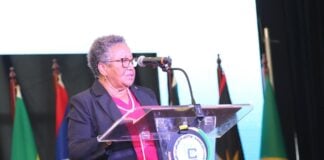
CARICCOM Secretary General, Dr Carla Barnett in a message to President Santokhi, said that the country can proudly reflect on the steady progress and the development it has achieved since 1975.
“Excellency, the Caribbean Community places great value on the role played by the Republic of Suriname to the regional integration movement, particularly in community development and cultural cooperation.

“Suriname’s motto and core values of justice, faith and loyalty have shaped its unique national identity and spirit. You can proudly reflect on the steady progress and development achieved since 1975, which is a testament to Suriname’s commitment to sustainable development,” she added.
Meanwhile the main opposition National Democratic Party (NDP) said that independence reminds the people of Suriname “of the complexity of the path we have walked since then.”
It said after centuries of colonial rule by the Netherlands, “our country still bears the heavy legacy of division, imposed by a divide and rule policy that hinders our development.
“The Netherlands, unlike other colonial powers, was known for deliberately sowing divisions between population groups in its colonies.
“This divide and rule strategy was intended to weaken resistance and strengthen the power of the colonizer. Unfortunately, we still feel the aftermath of this to this day in the form of social tensions and structural inequality,” said the NDP, whose leader, Bouterse has had public confrontations with the Dutch.
The party said that it is important to recognize that the Netherlands used this tactic not only in Suriname, but also elsewhere, such as in South Africa where it “introduced the “Act 9 Reserve,” the policy of which was to set aside separate areas for the black population, systematically excluding them from economic opportunities and isolating them from the political process.
“This was a subtle but destructive form of divide and rule that left deep wounds. Our struggle for independence and the subsequent process of decolonization was not only a struggle against colonial rule but also against the divide and rule practices that have sought to divide our country.
“Today, 49 years after our independence, it is time to reiterate that working towards the creation of ‘One Nation with One Destiny’ is essential for our future. The recovery of our country depends on our collective efforts to advance racial, social and economic equality,” the party said, adding that this Independence Day should be used “to reflect on our past, but above all to focus on a future of cooperation, peace and progress.